Key studyTechnology Validation
Dogs (n=20)In vivo light penetration measurement
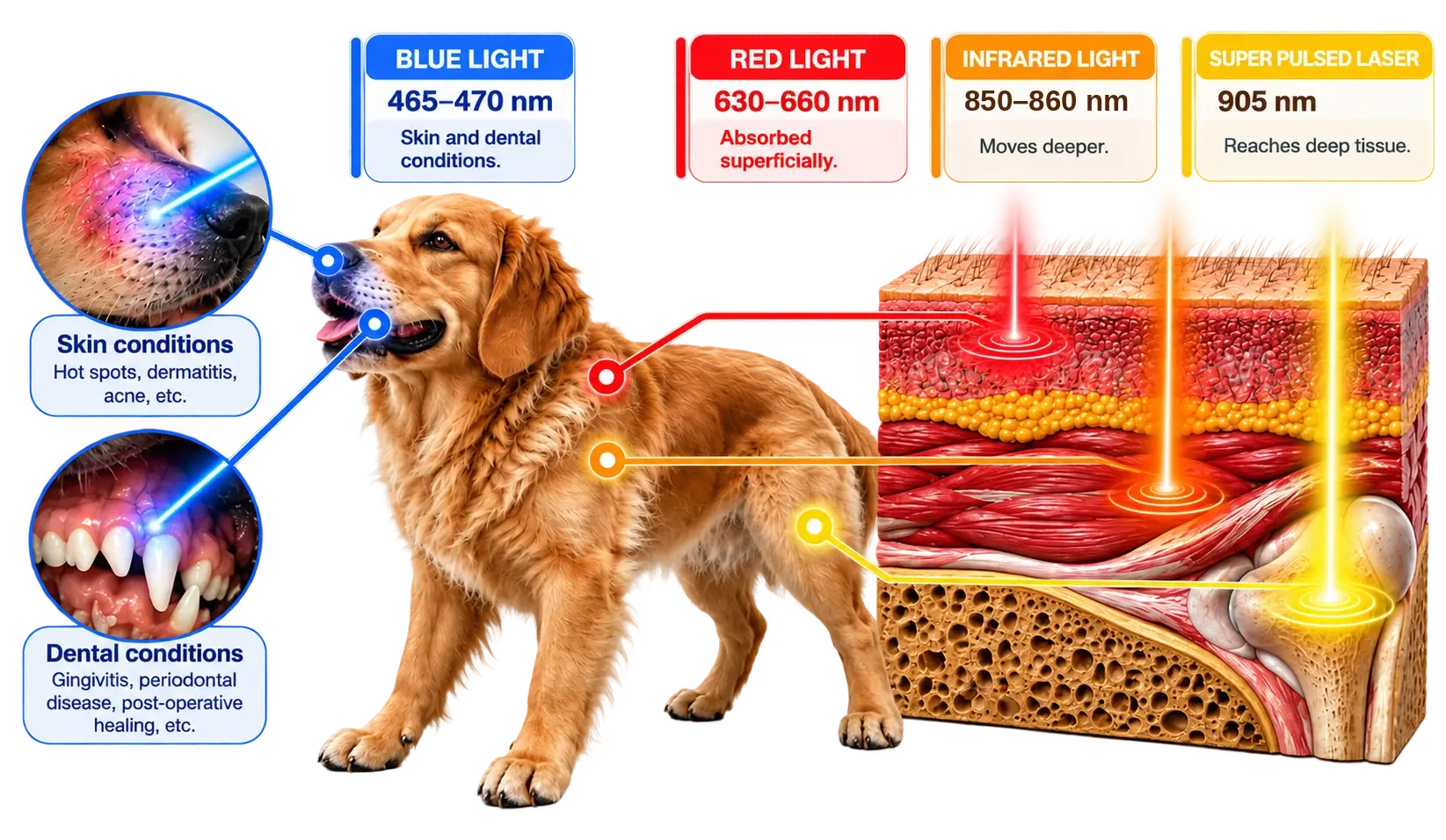
The light reaches the tissue in living dogs
Twenty client owned dogs were measured under anesthesia during abdominal surgery, with
a power meter placed beneath skin and beneath skin plus muscle. The authors concluded that the preset used
delivers sufficient energy for target tissue up to roughly 30 mm thick, and that treating in skin
contact delivers significantly deeper penetration than holding the emitter about 1 cm off the surface.
Transcutaneous light penetration of simultaneous superpulsed and multiple
wavelength photobiomodulation therapy in living dog tissue. Hoisang S, Seesupa S, Jitpean S,
Kampa N. The Thai Journal of Veterinary Medicine, 2022.
Key studyWound Healing
Dogs (n=21)Randomized controlled clinical trial
Faster chronic wound closure in client owned dogs
A randomized controlled trial in 21 dogs with chronic wounds compared standard care,
830 nm PBMT and simultaneous super pulsed multi wavelength PBMT. Mean wound area reduction at 15 days
was 42.4 percent for control, 57.0 percent for 830 nm and 61.8 percent for the
multi wavelength group, with a significant difference between treated and untreated groups by day 7.
Assessment of wound area reduction on chronic wounds in dogs with
photobiomodulation therapy: a randomized controlled clinical trial. Hoisang S, Kampa N, Seesupa S,
Jitpean S. Veterinary World, 2021.
Key studyOrthopedics
Dog (puppy)Case report
Bone healing after a surgical tibial fracture repair
A 10 week old puppy with a complete transverse proximal tibial fracture received
photobiomodulation with a static magnetic field twice daily for 21 days following minimally invasive plate
osteosynthesis. Radiographs showed advanced healing at 18 days and, at 55 days, an enlarged callus with
radiographic and clinical union. The authors note that randomized trials are still needed to confirm the
effect on fracture healing.
Photobiomodulation therapy combined with static magnetic field in tibial
fracture healing of a dog: a case report. Asteinza Castro IM, Amador Morga A, Johnson DS.
Veterinary Medicine and Science, 2023.
Key studyWound HealingTechnology Validation
Bacterial isolatesIn vitro laboratory study
Blue light against staphylococcal isolates in vitro
Blue light at 465 nm was applied to cultured isolates at three cumulative doses.
Colony counts fell significantly at every dose for meticillin resistant Staphylococcus aureus.
Reductions in meticillin susceptible and meticillin resistant S. pseudintermedius were not
statistically significant, which the authors attribute to differences in porphyrin concentration between
the organisms.
In vitro bactericidal activity of blue light (465 nm) phototherapy on
meticillin susceptible and meticillin resistant Staphylococcus pseudintermedius. Schnedeker AH,
Cole LK, Lorch G, Diaz SF, Bonagura J, Daniels JB. Veterinary Dermatology, 2017.
Key studyDermatology
Dogs (n=13)Randomized, double-blinded, sham-controlled trial
Acral lick dermatitis, a randomized sham controlled trial
Thirteen dogs on systemic antibiotics and trazodone were randomized to laser and LED
therapy or sham. Licking scores, lesion size and lesion thickness did not differ significantly between
groups. Hair growth was significantly greater in the treated group, a 24 percent increase
(P = 0.0081). The authors conclude that acral lick dermatitis requires multimodal management.
Is low level laser therapy useful as an adjunctive treatment for canine acral
lick dermatitis? A randomized, double blinded, sham controlled study. Schnedeker AH, Cole LK,
Diaz SF, Lorch G, et al. Veterinary Dermatology, 2021.
Dermatology
DogCase report
Hair cycle arrest in a Pembroke Welsh corgi
The first reported case of hair cycle arrest in this breed was managed with
photobiomodulation. Twelve total doses produced marked regrowth at the caudal thigh and dorsal
thoracolumbar region, quantified objectively by videodermoscopy hair shaft counts. The treatment was
noninvasive and well tolerated with no adverse effects appreciated.
The use of photobiomodulation therapy in the treatment of hair cycle arrest
in a Pembroke Welsh corgi. Bello K, Diaz S, Cole L, Lorch G. The Ohio State University College of
Veterinary Medicine, 2022.
Pain ManagementPerformance
Horses (n=8)Clinical investigation
Epaxial muscle response in ridden horses
Eight riding horses were assessed by algometry and acoustic myography before and after
treatment of the thoracolumbar longissimus and gluteus medius. Mechanical nociceptive thresholds did not
change significantly, while temporal summation scores improved significantly across walk, trot and canter.
The authors concluded the change in muscle firing pattern is consistent with what is seen with analgesia.
An investigation into the short term effects of photobiomodulation on the
mechanical nociceptive thresholds of M. longissimus and M. gluteus medius in horses at three different
gaits. Ahmed W, Elbrond VS, Harrison AP, Hart JO, Williams RE. Journal of Equine Veterinary
Science, 2020.
Technology Validation
Horses (n=12)Light penetration measurement
Deeper penetration than a Class IV laser in equine skin
Penetration was measured through unclipped light and dark skin in twelve horses using a
power meter, comparing a portable Multi Radiance device with a Class IV laser. Light penetration was
greater for the photobiomodulation device in both skin types (P < .001). This is the practical
answer to the assumption that more watts means more energy delivered to tissue.
Penetration profiles of a Class IV therapeutic laser and a photobiomodulation
therapy device in equine skin. Luna SPL, Schoen A, Trindade PHE, da Rocha PB. Journal of Equine
Veterinary Science, 2020.
Performance
Horses (n=24)Randomized controlled crossover study
Faster return to baseline after an acute stressor
Twenty four horses were randomized in a crossover design and given laser acupuncture or
sham before an acute startle test. Horses in the treatment period showed a smaller rise in heart rate
(p = 0.036) and returned to baseline heart rate faster (p = 0.045) than horses given
the sham treatment.
Effect of laser acupuncture on mitigating anxiety in acute stressed horses:
a randomized, controlled study. Ying W, Bhattacharjee A, Wu SS. The American Journal of
Traditional Chinese Veterinary Medicine, 2019.
PerformanceTechnology Validation
Mice (mdx)Preclinical study
Muscle protection and function, a dose response
Dystrophic mice were treated three times a week for 14 weeks at 1, 3 and 10 J.
The 10 J dose significantly improved functional performance over every other group
(p < 0.001), and muscle morphology improved at all doses, with the best outcomes at 3 and
10 J. Dose, not output power alone, drove the result.
Photobiomodulation therapy protects skeletal muscle and improves muscular
function of mdx mice in a dose dependent manner through modulation of dystrophin.
Albuquerque-Pontes GM, Casalechi HL, Tomazoni SS, et al. Lasers in Medical Science, 2018.
Technology Validation
RatsPreclinical study
What happens in the cell, and for how long
Transcutaneous treatment of the tibialis anterior in rats was analyzed at seven time
points from 5 minutes to 24 hours. The 10 J dose increased cytochrome c oxidase expression
significantly against placebo at every time point tested (p < 0.05). This is the mitochondrial
mechanism behind the therapy, measured rather than asserted.
Synergistic effects of combination of three wavelengths and different light
sources in cytochrome c oxidase activity in intact skeletal muscle of rats. Leal-Junior ECP,
Tomazoni SS. Clinical and Preclinical Optical Diagnostics II, 2019.
Wound Healing
Marine toads (n=33)Randomized controlled study
Safety and tolerability in an exotic species
Thirty three marine toads with surgically induced full thickness dermal wounds were
randomized to laser therapy, topical silver sulfadiazine or sham. Neither visual assessment nor histologic
scoring showed a healing benefit over control in these uncomplicated wounds. Both treatments were safe and
well tolerated, the first dosing and safety data reported in this class of animals.
Effect of Multiradiance low level laser therapy and topical silver
sulfadiazine on healing characteristics of dermal wounds in marine toads (Rhinella marina).
Archibald KE, Harrison T, Troan B, Smith D. Veterinary Medicine International, 2020.
No studies in this category yet.
No dental studies are listed yet. Dermatology & Dental shows dermatology and blue light research.